IPExplorer origins

I guess it depends on how small we are talking, and exactly what the parameters are.

If you are monitoring some analog signal and once a second polling it, and checking a delta, then storing the value to a CSV, you probably don’t need a powerful processor, you could possibly get away with a Pi Pico, or ESP32 or something, and they would be power effecient to keep power draw to a minimum for battery life. If you wanted to store files in a more complex format, dbf, sqlite, parquet, that would probably require more processing power….but honestly something like an ESP32 still might be fine, especially if we are looking at 1s+ polling rate.

There probably isn’t going to be much to configure, if it’s just monitoring the signal it’s connected to, you might need to configure what, the file type it stores at (if we want that to be configurable), and possibly polling rate?

Polling rate could be done using dip switches, or you could possible save some space by having a config file?

If the device is being plugged into a USB to offload it’s stored files, there could be a config file on there that can set the file type and polling rate. Plug it into a computer, it charges, grab your files, change your polling rate in the config file, then go hook it up to whatever else.

I would imagine physical size limitations would come from the analog circuitry and storage capacity for the data.

Pi pico’s, and ESP32s aren’t big, and probably do enough for what is needed processing wise.
So I like the idea and see a need for a data logger, but…. thinking about development cost, tooling if we cant find anything already and price point, is this something that can be done with a Click PLUS?

A Click 02CPU with a combination card would run about 200 and can store the data, would just need a USB cable or Ethernet and another 50 bucks would get you WiFi and this would cover analog and digital

I dont know if I see the profit, thoughts?

Very valid points. I’ve personally never used anything from Automation Direct (although I’ve heard good things), so I can’t really speak for how well they do.

Doing a quick search around (not very thorough) I did find this: DI-1100 USB Data Acquisition Starter Kit

I haven’t really looked into the details, but it looks like in general it’s kind of what we are discussing here.

One downside I guess of something like the Click Plus over what we are discussing would be potentially size, and also I don’t know how easily it would be to wire a battery up to a Click Plus or how long it would last, or how portable it would be once you do.

For someone working at a plant it may not be a big deal, but something small and easy to throw in my backpack as an SI could be useful. …is it worth the time and development costs compared to a Click Plus or that DataQ device, hard to say…maybe not especially if that DataQ device could do the job.

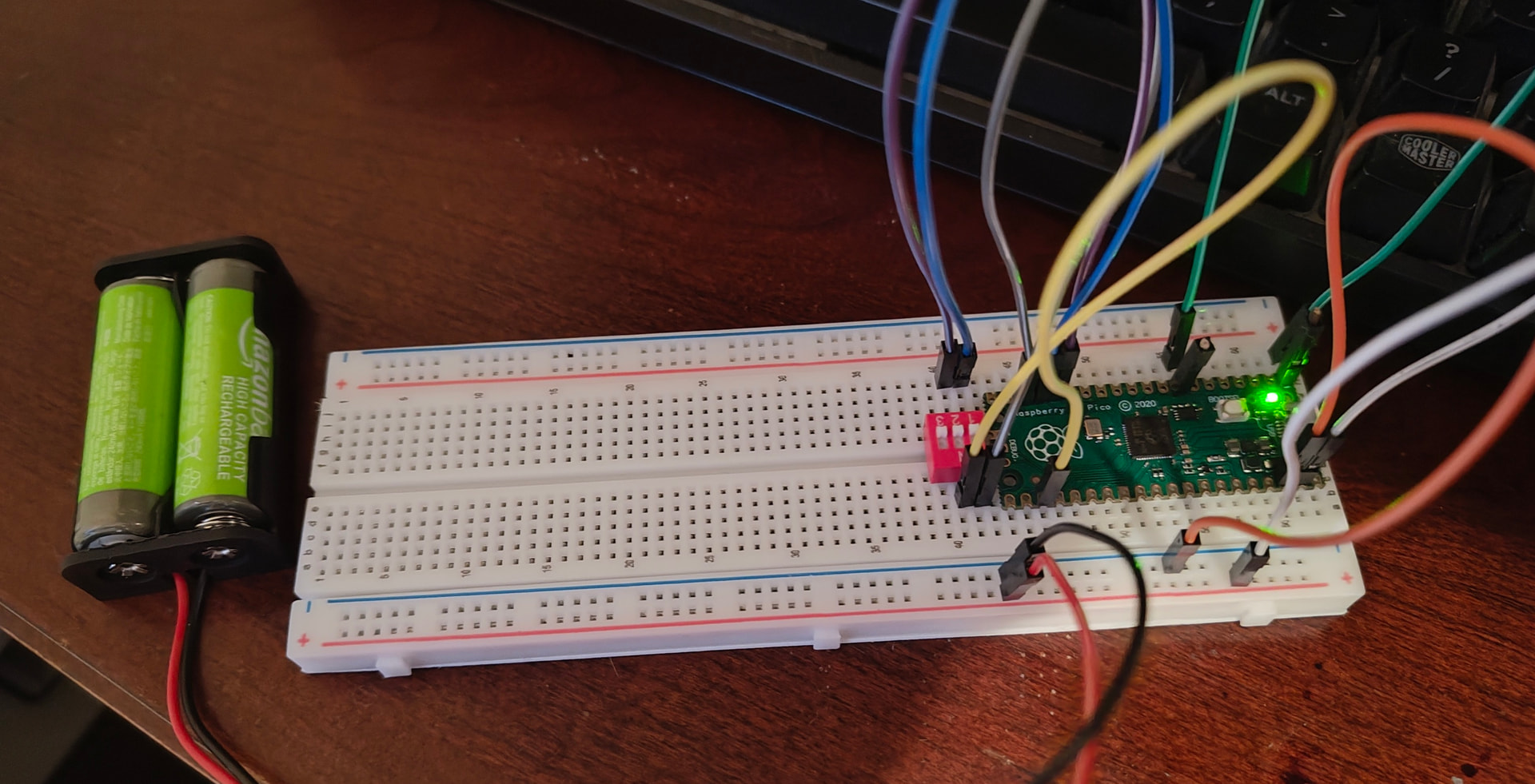
I have a RP2040 logging to its internal memory. If I logged at a 1s interval it should have enough internal memory to log for 24 hours. Logging only on meeing a change threshold, it would log longer.

I’ve also successfully powered it with 2 AA batteries. I’m working on making the log interval configurable with dip switches. That part should be easy, though pluggin in USB and editing a config would be easy too.

Well then there is the price point… that would be cheaper than the Click and depending on the additional hardware may have sounds like there would be enough for a profit, I have never used them before

Yeah, For something like this an RP2040 would probably work. The ESP32 depending on the model is a similar price point. For example this ESP32-C6 Dev board should be pretty close price wise to a an RP2040 dev board: https://www.waveshare.com/product/arduino/boards-kits/esp32-c6/esp32-c6-zero.htm

logging its internal temperature off of 2 AA batteries. I need to modify my logger to capture when it stopped logging so I can know how long the battery lasted.

3 Likes

It was still running when I left for work, about 9 hours so far.

2 Likes

I mentioned rechargeable, but using a couple of AA’s would be acceptable.

Yeah, I’m just tinkering. Those batteries are rechargeable, though I know that is not what you mean. I’m seeing if I can get to a proof of concept, find out what I don’t know and see if I can figure it out.

Speaking with someone who makes things and knows things, I hear lithium batteries adds complexity on the business side of things (insurance, shipping).

Yeah that makes a lot of sense, I still see some places talk about various issues shipping things with batteries.

I wonder if NiMH batteries would be a good compromise?

That is what I’m using for batteries. I’m curious to see if it is still going when I get home

1 Like

Yeah this is why I was thinking something like a Pico could work for this…they are pretty low power, and I really wouldn’t think you would need much processing depending on the file format used.

Not just shipping lithium batteries, but I had to travel to Hong King & China for a trade show in 2017 and airports there, and the Chinese airline check-in at O’hare in Chicago, had scanners that detected lithium batteries in carry-on AND checked luggage.

Only one power bank that was not over over 1000mAH, no other third device with lithium batteries no matter how small they were (I had a rechargable flashlight in my checked bag that was brought right back out for that) The battery in that flashlight never left Chicago.

The only lithium batteries allowed were a phone and a laptop or tablet.

All phones had to be powered down while on the plane the entire flight and could not be charging, not just airplane mode. They knew when a phone was powered on as soon as it was powered on and confiscated more than one on the flight that would be returned at the baggage claim area

PS- when you fly on a Turkish Airlines plane and charge your phone, the phone will show “USB Data Transfer” and if you try to change it in USB Options it will show “USB Controlled By: Connected Device” and you can’t change it. Then my malware app alerted me to someone accessing the data files on it, that’s when I unplugged it and plugged it into my laptop. Someone on the plane is getting into all phones plugged in.

Plus an odd thing about Turkish Airlines planes - every other plane you can open Maps and see where you are and how fast you’re going, but Turkish Airlines planes always show you parked at the airport next to the Boeing factory. Guess they don’t want any missiles tracking them. And those flights were between Hong Kong and Istanbul, Turkey.

That’s a good point @I_Automation, having a portable thing that is difficult to travel with certainly would be a problem.

I’m using CircuitPython @vadoola, it doesn’t have a CSV module so I’m just logging to a text file. I think there are 3rd party CSV modules, I’ll have to see if it is worth it down the road.

Yeah I wasn’t really thinking about it but my last two flights, back in Oct/Nov and Dec/Jan they were being more strict about battery banks, and we weren’t allowed to charge phones etc on the plane either (although we were allowed to leave them on in airplane mode)…but considering these were 15+ hours flights, I powered off my phone anyway.

I’ve heard of CircuitPython, but never touched it….to be fair creating a CSV with just plane text file logging isn’t difficult, it just requires a bit more formatting logic.

I have a couple things I would like to do with a nicely packaged portable Pi. The main two in mind:

Wireshark and reverse engineer setting IP on a Click either through Ethernet or serial. I’ve really been liking them as remote racks in a primarily Rockwell facility. I used eleven Pluses as remote racks for conveyor conversions. Final result used two discrete in, two discrete out, two analog in, and one analog out in a nice small footprint. I used the generated EDS for that. I can plug in a C-More micro and test run and adjust speed locally. I posted on PLCs.net about that application.

Another two I used as a generic module. Periodic cycling pumps are controlled by an indirectly related system. When everything is up, the main system runs the PF525s. When the main is off the Click sees loss of comms, triggers start and speed selection 2, and continues to run the pump hardwired at the last selected speed and cycle times from wherever in the cycle it was. A C-More Micro there allows adjustments if desired while the main system can now be LOTO’d for much longer times as applicable.

We were asked recently to put some tank levels on manufacturing HMIs. Two more Clicks with analogs read by explicit messages made that quick and easy.

I guess that evolved or devolved into some rambling about things I like about the Click. The only thing I don’t like is I don’t have a portable battery power device to easily set IP.

The other thing I want to do with a portable Pi: a packaging machine with inaccessible program needs a laptop booted up and an Excel script run just to unlock and lock a HMI settings button we need occasionally. We did reverse engineer that, but we don’t have anything notably better than a laptop to run it. A little box to plug in with lock and unlock buttons… that would be nice.

1 Like

Honestly more than anything I’m curious how this is set up. I can’t imagine doing this with a Pi would be complicated, is it just setting a bit in the PLC or something? I’m trying to figure out what this Excel script would be doing

If it is toggle a bit then a micro HM, or any HMI type program, could toggle it.

Even Node-Red if able to talk to that PLC could read an input from somewhere and send that bit command.